
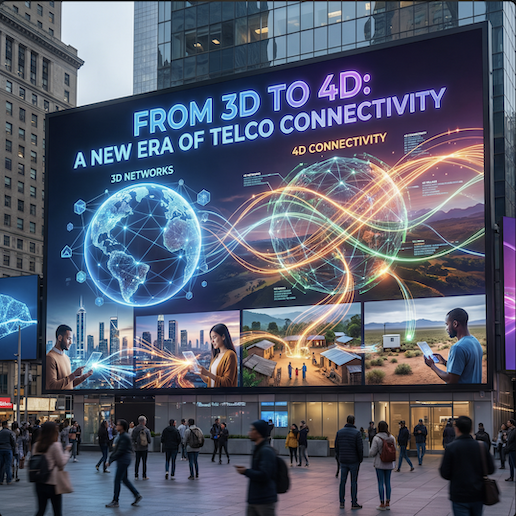
From 3D to 4D connectivity - the new dimension changing everything
“Coverage, capacity and latency are critical, but they’re no longer enough - we need to clearly determine the problem the network is trying to solve.”
Grant Smith, Teleauora CEO
For decades, the telecommunications industry has evaluated networks through three familiar dimensions: coverage, capacity and latency – where does the signal reach, how much data can it handle, and how quickly does it respond?
The reality is that this framework worked when connectivity primarily served people using smartphones and computers. But today, as we know, the landscape is fundamentally different and much more complex.
We are no longer connecting billions of individuals alone; we’re connecting hundreds of billions of devices. Sensors are monitoring ecosystems everywhere in real time. Industrial robotics depend on ultra-low latency performance. Drones survey infrastructure across vast regions. Wearables enable continuous health monitoring. Autonomous systems manage logistics and transport.
Teleauora’s CEO, Grant Smith, suggests this shift requires a new way of thinking.
“Coverage, capacity and latency are still critical,” said Grant.
“But they’re no longer enough. The real question isn’t just how strong the signal is, it’s clear determination of the problem that the network is there to solve. I consider this the key fourth dimension use case.”
Introducing the fourth dimension use case
Grant describes this evolution as the move from ‘3D connectivity’ to ‘4D connectivity.’
“The full spectrum of technologies already exists,” he explained.
“Fibre delivers extraordinary capacity in dense environments. Public and private 5G enable mobility and low-latency applications. Satellite constellations extend reach to remote and oceanic regions. Narrowband IoT supports sensors that operate for years on minimal power.”
The constraint, he argues, is no longer technological capability, it’s strategic alignment.
“The innovation gap isn’t about inventing something new,” said Grant.
“It’s about deploying the right combination of technologies for the right application. One-size-fits-all networks simply don’t reflect the complexity of today’s digital economy.”
Focus on purpose-designed infrastructure
When connectivity is engineered around real-world applications rather than broad geographic coverage, outcomes scale.
Precision agriculture systems powered by narrowband sensors and private 5G can significantly reduce water consumption and chemical runoff. Secure, low-latency private networks enable advanced telemedicine and remote diagnostics, expanding access to healthcare beyond major metropolitan centres. Smart infrastructure reduces congestion and emissions while improving safety and efficiency in industrial environments.
“These are not incremental improvements,” noted Grant.
“These are transformational shifts that occur when infrastructure is aligned with operational need.”
This mindset also reframes the conversation about access.
Billions of people and communities remain underserved because they fall outside of traditional commercial footprints. Blanket deployment models prioritise density and short-term return. A use-case-driven approach creates new pathways to viability.
“Connectivity should not be determined solely by postcode economics,” said Grant.
“When we design around specific challenges, whether those be environmental monitoring, remote education, industrial automation or emergency response, we realise the potential for more sustainable models that serve communities previously left behind.”
Building the 4D connectivity ecosystem
Teleauora’s strategy reflects this philosophy. The company designs and deploys dedicated connectivity solutions, including private 5G networks and advanced Fixed Wireless Access, tailored to defined performance, resilience and coverage requirements.
Equally important, Grant talks about the importance of collaborative partnerships that leverage specialist areas of expertise.
“No single operator can solve this alone,” he said.
“We collaborate with infrastructure providers, technology innovators and regional stakeholders to build ecosystems globally, not in silos. Shared knowledge, aligned deployment models and practical cooperation is what will accelerate our impact and reduce duplication.”
The future of connectivity, Grant says, belongs to those who stop asking how to blanket a map and instead start asking more precise questions around the challenge being solved, the performance characteristics truly required, and the combination of technology that will deliver the greatest long-term benefit.
“We already have the tools,” concluded Grant.
“The next massive leap forward is about vision and intent, applying those tools intelligently, equitably and strategically. In my mind, that is what 4D connectivity represents.”